English 6 Unit 1 Term 1 Week 4, 2025
Instrucciones:
• Los bloques sombreados en color gris se pueden ocultar en la impresión final.
• Para ello haga clic sobre cada uno de los bloques que desea ocultar.
• Para encenderlo nuevamente, pulse el bloque otra vez.
• Solamente los bloques encendidos serán impresos.
• Pulse el botón «Imprimir» cuando se encuentre listo.
• Para un mayor aprovechamiento del espacio, recomendamos eliminar los márgenes al imprimir.
¿Cómo guardar PDF?

Recomendamos utilizar el navegador Google Chrome.
Si no lo tiene instalado en su dispositivo puede descargarlo aquí.
El diálogo de impresión iniciará en cuanto cierre estas instrucciones.
En el cuadro de diálogo, cambie el destino de la impresión:

En las opciones, seleccione «Guardar como PDF»:

Para aprovechar todo el espacio de su hoja, recomendamos desactivar los márgenes:
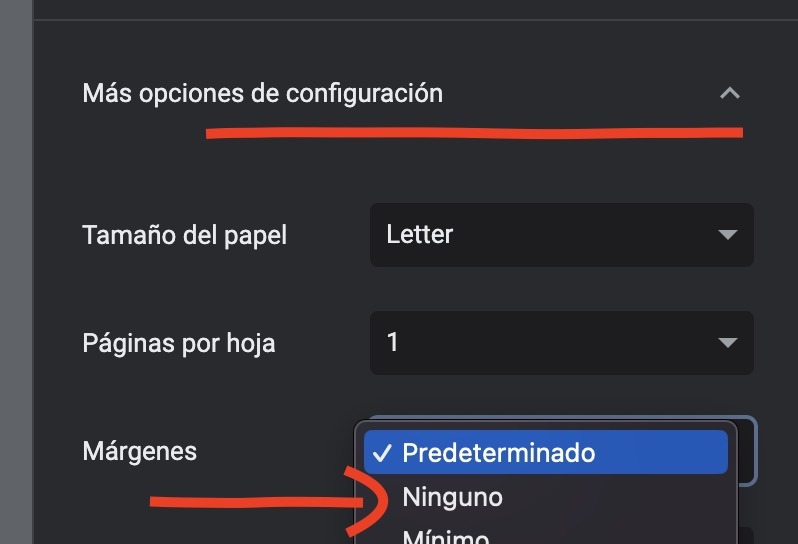
Por último pulse el botón «Guardar»:

¿Cómo imprimir en color?
Recomendamos utilizar el navegador Google Chrome.
Si no lo tiene instalado en su dispositivo puede descargarlo aquí.
El diálogo de impresión iniciará en cuanto cierre estas instrucciones.
En el cuadro de diálogo de la impresión siga las siguientes instrucciones:
Si desea imprimir el planeamiento a color, asegúrese de activar la opción «Color»:

En la sección «Más configuraciones»:

Active la opción «Gráficos de fondo»:

Finalmente pulse el botón «Imprimir»:

School year: 2025
Period:
Term: I
Level: Sixth Grade
Unit:1
Week: 4
Domain: Socio-interpersonal
Scenario: Costa Rican Heroes
Theme: I Can Be a Hero
Enduring Understanding: Heroes make sacrifices to improve the lives of those they serve.
Essential Question: What actions define a hero?
General Competences:
Responsible Citizenship ( X )
Life Competences ( )
Competences for Employability ( )
Learn to Know
Grammar & Sentence Frames
Sequencing adverbs with Modal “must”• First I must know the need.
• Next I must make a plan.
• Finally, I must thank my team.
WH Questions
• What made (name of person) a hero?
• Who is your hero?
• Why is he/she your hero?
Past Tense
• The police officer stopped the speeding car.
• The firefighter ran into the burning building.
• The young woman saved the life of her baby.
Phonemic Awareness
• Decoding two- or three-syllable and compound words (e.g., sa/cri/fice, su/per/he/ro, com/mu/ni/ty).
Vocabulary
4. I can be a hero
How can you become a hero?
• First, I can help my classmates.
• Then, I can help my teacher.
• Finally, I can help people in my community
• I must study hard.
• I must be kind to people.
Learn to Do
Function
- Retelling/relating past events using connectors
Discourse Markers
Linkers: Sequential – past tense
First, then, after that, finally
Learn to Be and Live in Community
Psycho-social
- Explaining motivations to improve/change lives.
Socio-cultural
- Using different choices of greetings and leave takings according to context.
- Expressing positive politeness to express admiration, affection and gratitude.
Idioms/ phrases
- To take the bull by the horns. (To make something hard in a brave determined way).
Assessment Strategies & Evidences of learning
Learner…
Goals
Learner can…
Pedagogical Mediation/ Didactic Sequence
Pre-teaching
Teacher asks students: Do you think regular people can become heroes? Do you think you could be a hero someday?
Warm up
Students brainstorm about different activities that make people heroes in real life. The teacher writes some on the board.
Activation of Prior Knowledge
Students read about Juan Santamaría on page 13. Students answer some questions about the text.
The teacher writes the questions on the board. Students answer the questions on their notebooks.
Answer the following questions according to the reading on page 13.
Juan Santamaría
- What position did Juan Santamaría have in the army?
- What was Juan Santamaria’s condition to set the hostel on fire?
- Why was Juan Santamaria called the Erizo?
- Where was the battle where Juan Santamaria fought?
- Why was his contribution important for Costa Rica?
Modeling
The teacher explains how regular people can be heroes daily.
A doctor can be a hero because he/she can save people’s lives.
A teacher can be a hero because he/she can help children stretch their boundaries.
A friend can be a hero because he/she can listen when somebody needs support.
Clarifying
Teacher explains sometimes regular people with regular jobs can become heroes in special occasions like Juan Santamaría.
Time
L.1.gets the main idea of a short text when read aloud clearly and slowly.
L.1.1. identifies relevant information (who, what) in a short text about heroic actions when read aloud clearly and slowly.
L.1.2. gets the main idea of a short text about people’s achievements and personal characteristics when read aloud clearly and slowly.
L.1. Get the main idea of a short text when read aloud clearly and slowly.
Pre-task
Teacher asks students: Who is a bully?
Students brainstorm some actions that represent bullying.
The teacher writes them on the board.
Students brainstorm some ways to tell people to stop bullying.
Task-rehearsal
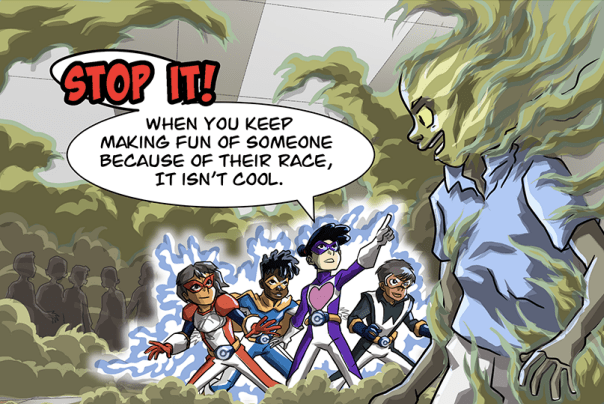
The teacher reads a comic from Captain Compassion taken from captaincompasion.org, read week 2 (see link, Unit 1).
Resources: https://www.cfchildren.org/resources/bullying-prevention-information/
Students ask for new vocabulary if there is any. Teacher asks students:
- Who is the bully?
- Who are the heroes?
- How are they helping?
The teacher writes some of the vocabulary on the board.
The teacher shares a copy of the comic for students to
Task completion
Students work in groups of three and prepare a poster to paste on the walls of the school with an antibullying message.
Students must add a picture and a message asking students to become a hero by stopping bullying.
The posters may be done on a piece of a posterboard (cartulina), construction paper or regular white paper.
Teacher must check the spelling and grammar of the message before it is written on the poster.
Task assessment
Students share their poster in the class with their classmates.
Post task
Paste the posters around the school and share them with younger students.